The 10-yard roll-off measures about 12 feet long, 8 feet wide, and 3.5 feet tall, so it slides onto a single-car driveway with room to open a car door beside it. That low profile is why it fits the tight HOA lots in…
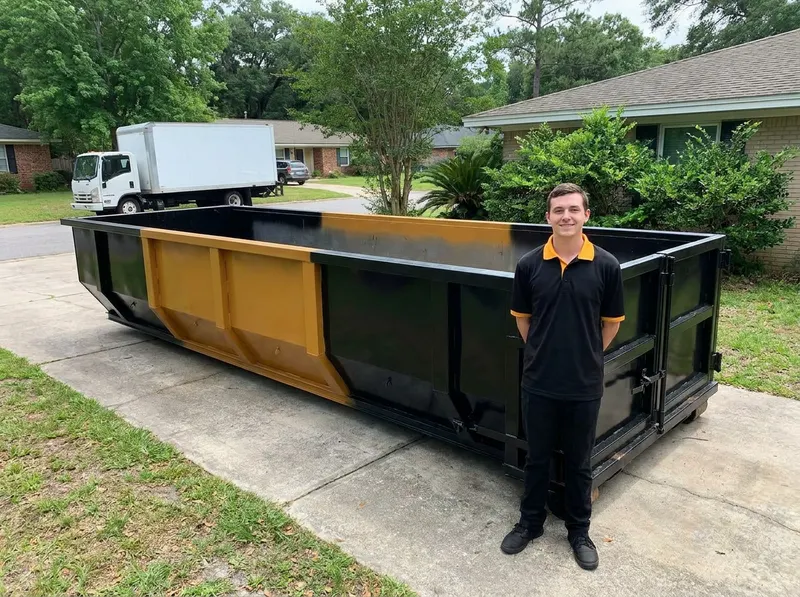
The 10-yard roll-off measures about 12 feet long, 8 feet wide, and 3.5 feet tall, so it slides onto a single-car driveway with room to open a car door beside it. That low profile is why it fits the tight HOA lots in Killearn Estates and SouthWood, where a 30-yard would swallow the whole apron and clip an oak root or a retaining wall. On the narrow drives of Indianhead Acres and Lafayette Park, the short footprint clears the mailbox and the neighbor's line without a spotter.
Step 1: call or text a photo of the debris and pick a drop date. Step 2: our team backs the roll-off onto the driveway or curb, setting boards under the wheels to protect pavers and asphalt from the roll-off's weight. Step 3: load it, the 10-yard fills to its 12-foot rim without a walk-up ramp, unlike the taller 40-yard. Step 4: call for pickup within the rental window. Step 5: the loaded container hauls to the Leon County disposal site and the flat price already covers the dump ticket.
Size is the whole decision. A 10-yard suits a bathroom or kitchen gut, a single-garage cleanout, or a small roof tear-off of asphalt shingles, because those loads are heavy but low in volume, 10 yards of shingles or concrete already approaches a legal road weight, so a bigger box would not legally hold more of it. If the job is a whole-house cleanout in Betton Hills or a construction remodel throwing bulky drywall and cabinets, step up: the 15-yard runs $650, the 20-yard $695, the 30-yard $795, and the 40-yard $895. The trade-off is driveway space against debris volume, the 10-yard costs the least and takes the least room, but light bulky junk fills it fast, while dense material like the demolition rubble covered under the EPA's construction and demolition debris guidance maxes it on weight first.
Heavy material carries a hard rule: dense loads such as concrete, brick, and dirt should stay to about the bottom third of a 10-yard so the axle stays under legal limits and the container leaves the driveway in Myers Park or Waverly Hills without dragging. Roofers stripping a small ranch near Golden Eagle or a Midtown bungalow use the 10-yard for a single layer of shingles; a heavy two-layer tear-off may need a second haul. Yard debris after a storm, the kind the Florida Department of Environmental Protection tracks for disposal, loads clean into the 10-yard as long as it is free of dirt clumps and root balls that spike the weight.
Prohibited items keep the load legal and the flat price intact: no household hazardous waste as defined by the EPA, no paint, no tires, no batteries, no appliances with refrigerant, and no liquids. Freon-bearing units fall under the EPA's Section 608 refrigerant rules and go separately. A dumpster rental is not junk removal, the customer loads the container, and Kenny Dumpster Rental delivers, hauls, and disposes. For placement in public right-of-way, the City of Tallahassee may require a permit; on private driveways in Frenchtown or Lafayette Park no permit is needed. Loading crews should follow basic OSHA jobsite safety practices to keep footing clear around the container.
Every job gets a firm, written price after an on-site visit.
Tell us about your 10-yard dumpster rental job in Tallahassee and we'll send a clear, written quote, usually the same day.
 Kenny Dumpster Rental